

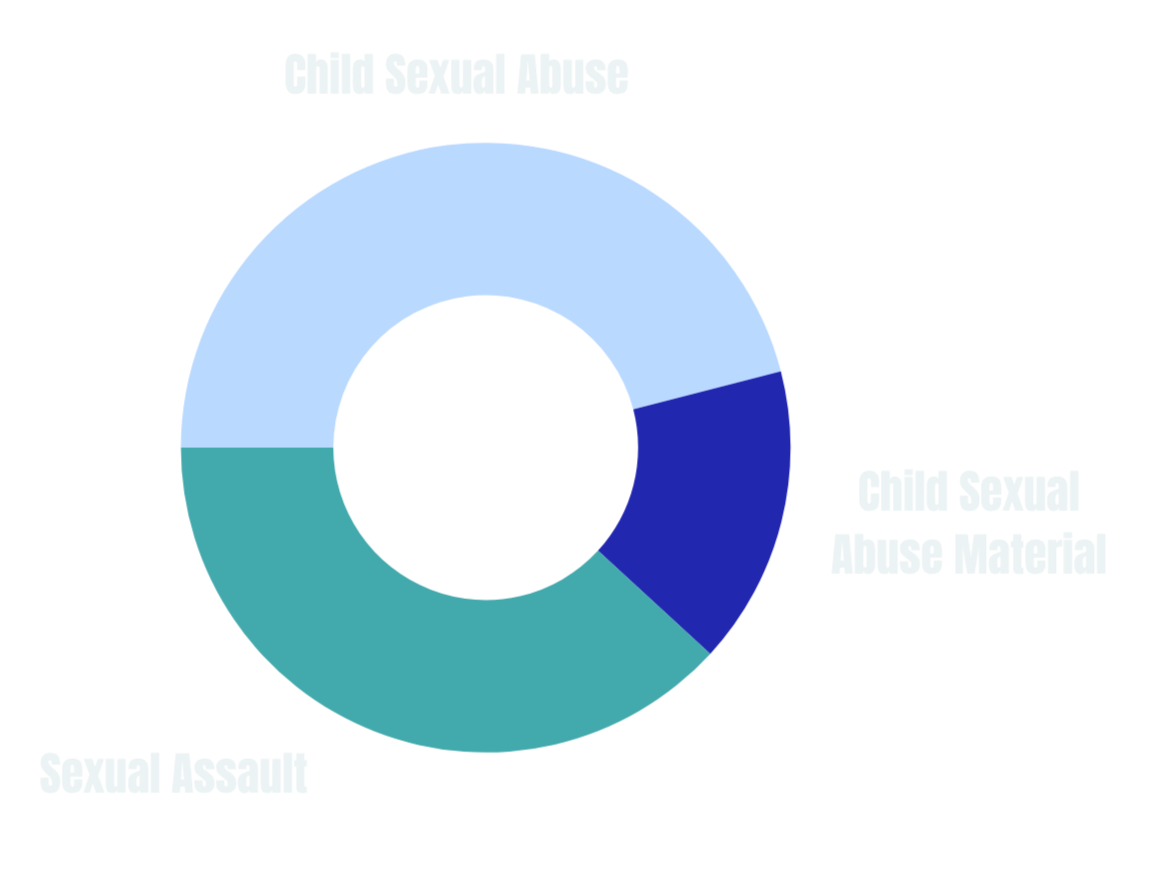
Children across the country experience widespread sexual abuse by law enforcement.
In 2025, over 60 percent of officers arrested
for sex crimes involved child sexual abuse.
This abuse can occur on-duty and when officers are off-duty. Both contexts abuse an officer’s implicit power over their community.
In 2025, a Houston police captain and 32-year veteran of the force was accused of sexually abusing a girl off-duty, beginning when she was just 9 years old. He allegedly raped her 85 to 100 times and threatened to “ruin her life” if she told anyone.
Though he may have been off-duty when the abuse occurred, his status as a police captain is always present.
Officers are the very people we are taught to trust with our safety from a young age. We sign a distinct social contract with law enforcement every day — we provide them with enormous power over us with the agreement that they “protect and serve” our communities, and yet they break this contract,
time and time again. Where do children go for help if the same people meant to “protect” them are the same people abusing them?
How do officers get access to children?
School Resource Officers (SROs), or police officers placed at schools, are statistically significantly more likely to be arrested for a sex crime compared to their counterparts.
In 2026, at least a dozen school resource officers have been arrested for sex crimes, including this deputy sheriff in Florida,
who was arrested for sexually assaulting students on-duty and in his at-school office for years.
Philadelphia paid $2.3 million to two women who were sexually assaulted at 9 and 11 years old by then-school resource officer
Patrick Heron. He is currently serving prison time for sexually assaulting at least 48 women and children.
Research surveys have shown that girls at school report feeling no safer with the presence of SROs at schools. Instead, placing officers in schools is providing opportunity for powerful, armed adults to have unsupervised access to children.
Police Explorers programs, or youth development programs for children interested in a career in law enforcement, are also known to be predatory environments.

Every year, officers are arrested for sexually abusing children they met while running Explorers programs.
In 2026, this police officer in California who served as the supervisor for their local Explorers program was charged with sexually abusing a participant. Headlines accuse him of “having sex” with a teenage girl. As a reminder, minors cannot “have sex” with adult men. Minors are raped by adult men.
Of all of the cases of sexual abuse in Explorers programs, most famous is likely that of Sandra Birchmore. Sandra had been groomed and sexually abused by several local police officers from the age of 15, after she had joined her local Police Explorers program. In 2021, Sandra (who was pregnant at the time) was found dead at the age of 23. In 2026, Matthew Farwell, one of the officers who had groomed and sexually abused her, was convicted of her murder and an attempted cover-up.
Nearly 40 percent of all police officers convicted of child sexual abuse
never see a single day in jail.
In 2024, the Washington Post, in partnership with Bowling Green State University, reviewed arrests of officers for child sexual abuse between 2005 and 2022 and found that nearly 40 percent of those convicted avoided any prison time.

And the sentencing trend continues.
In 2026, to name a few:
This police officer in Alabama
This police officer in Minnesota
This probation officer in Massachusetts
And this deputy sheriff in North Carolina…
…pleaded guilty to sex crimes against children -
and all were given probation.
No jail time.
How are so many officers able to avoid jail time?
The answer is multifaceted.
Legal cases involving children can be extremely difficult. Kids are understandably fearful of the legal system and hesitant to testify. Rarely does the legal system take adequate measures to lead with trauma-informed care when working with young people. Without the testimony of those impacted, prosecutors are far more inclined to give a predatory cop a lenient plea deal.
Prosecutors are incentivized to keep amicable relationships with local law enforcement, as prosecutors rely on officers to testify in other legal cases to maintain a high prosecutorial record. Our legal system still trusts the word of a police officer over that of a child.
In South Carolina, at least six teenage students say they filed complaints of sexual assault against a school resource officer to both the local school district and the sheriff’s department. The students allege the sheriff’s department refused to investigate or file charges for years, after the first report was filed in 2015. The officer continued to sexually abuse students until 2019, when he was fired and charged with sexual misconduct.
In 2024, he was sentenced to three years of probation — no prison time.
Perhaps more important to recognize is how resistant prosecutors are to charging
officers with sex crimes.